|
|
|
|
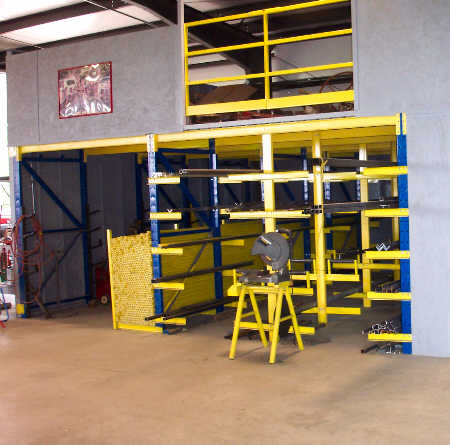
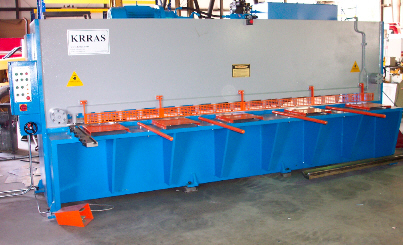
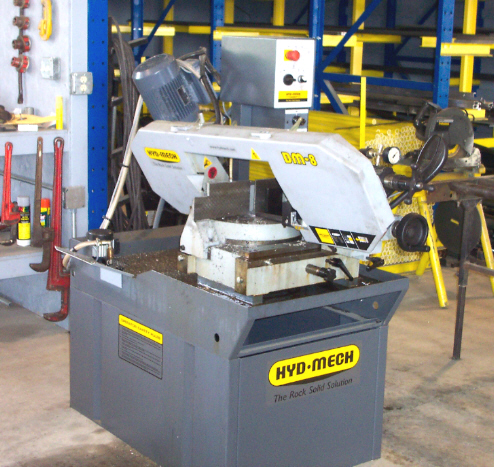
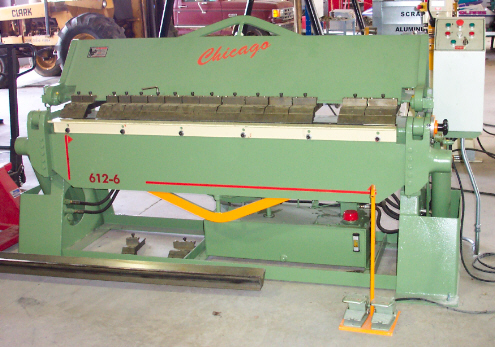
Welcome to our fire apparatus shop. Here we take your idea from a simple sketch or thought and transform it into a working piece of equipment. Below are pictures of some of the equipment we use to accomplish the task. Most likely, your idea will start to become a reality at one of the stations below. The first picture is our storage area for bar stock, tube and angle. The second picture below shows our shear. This unit can accommodate a 12 foot wide piece of material. Thicknesses it can handle vary by material but, it will take up to 1/4" of 60,000 PSI steel and 3/8" thick aluminum. To the far right is our horizontal metal cutting band saw. It makes short work of cutting through structural members and can easily make repeatable compound angle cuts.
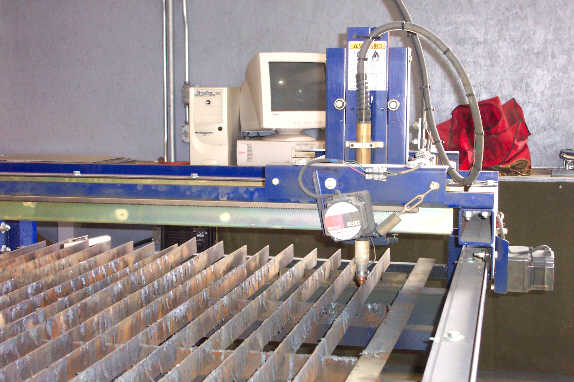
Some materials will get their start on the rig seen to the right. It is a CNC plasma torch. The unit can cut extremely complex shapes out of aluminum or steel with an accuracy of .001". With this torch we have the capability to cut out virtually anything we can draw in Autocad. It can cut 1" thick steel like butter and slices through 3/16" steel at over 200 inches a minute.
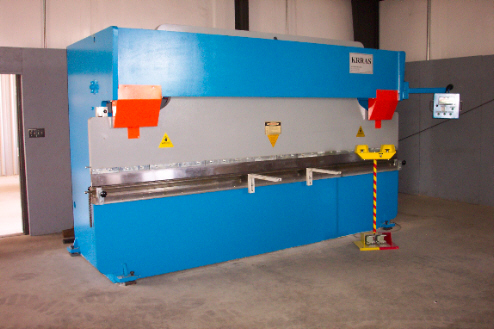
The brake is equipped with numeric controls and a backgauge
which allow us to make repeatable, accurate shapes. The combination of a
gooseneck punch with a multiple vee die allows this machine to handle any
material we need bent.
With it's production package, a single person can chop a 22' length of angle iron into exact 12" lengths in about 40 seconds.
Fabricating our tanks from Co-Polymer Polypropylene requires some dedicated and specialized equipment. The item below is our panel saw. This saw allows the operator make a perfectly straight, clean, and quick cut through even the thickest plastic stock. This saw is kept next to our plastic storage rack as seen below.
Hydraulic tables allow the operator to get the tank to the most ergonomic height possible. This allows the welder to operate at peak efficiency since they can concentrate on the task at hand rather than being in an uncomfortable position. (The tank pictured will be a skid unit.)
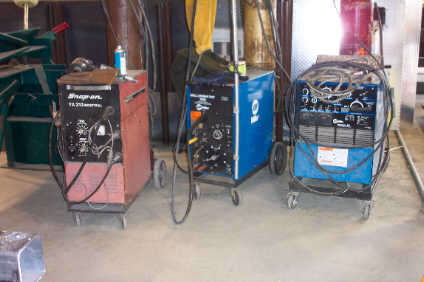
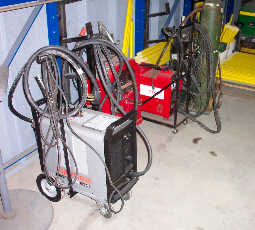
Welding polypropylene requires very specialized equipment. This picture shows two welders. The unit on the right is a "torch" that is used for tacking parts together, making small width welds and for the root pass of a large weld. The unit on the left is an extrusion welder. That welder takes in 1/8" diameter rod, chops it up, heats it, and then extrudes the molten material through a special teflon welding shoe to form a very wide, single pass weld.
Below is one of the special fittings we use in our overflow plumbing inside the tanks and the equipment used to fuse it. Since the overflow passes through baffles and may have a few turns in it, it would be nearly impossible to weld it in place. If you look closely at the female socket of the elbow you will see a matrix of wires around the circumference. These wires do the welding for us when the electronics are connected to them. By using this device and the special fittings we can dry fit the plumbing in place, connect the device and weld all of the fittings at once with a guaranteed seal the customer will never have to worry about.
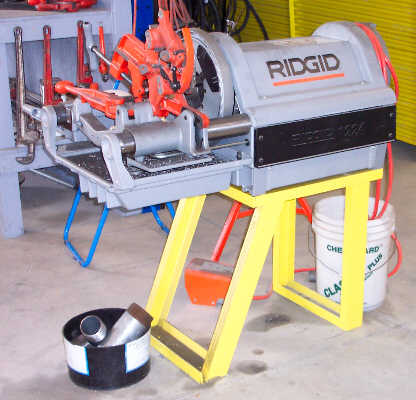
The below items are for tube and pipe bending. The unit on the left is our pipe bender. It is capable of bending up to 2-1/2" schedule 40 pipe and just about anything smaller (which is a whole lot.) The machine on the right is a notcher. The notcher machines the ends of pipe to conform to the side of another pipe at nearly any angle so they may be joined perfectly.
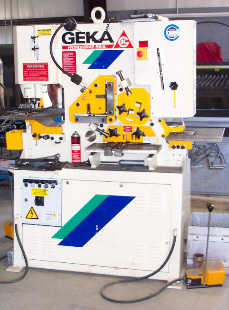
We use the press below for two dedicated functions. One set of dies is used to pop louvers into our aluminum sheet. By doing this we do not have to purchase and weld pre-fab louvers into place and then grind the welds. The other set of dies is used for rounding corners. By using the rounding dies, the corners of our fabrications are consistent and even every time.
|
|
Copyright © 2006
David's Fire Equipment
|
.JPG)
.JPG)
.JPG)
.JPG)
.JPG)
.JPG)
.JPG)
.JPG)
.JPG)